

Introduction: That Symptom You’ve Been Ignoring — Is It Serious?
You’ve been putting it off for weeks. Maybe months.
The burning when you pass urine. The back pain that won’t go away. Waking up three or four times every night to use the bathroom. You tell yourself it’ll pass. You try more water, a home remedy, a tablet from the local pharmacy.
But it hasn’t passed. It keeps coming back. And somewhere in the back of your mind, you’re wondering — *should I get this checked?*
This article is for you.
Across Jaipur and Rajasthan, thousands of patients delay seeing a urologist — not because they don’t care about their health, but because they don’t know when a symptom crosses the line from “wait and watch” to “see a specialist now.” The result is conditions that could have been treated simply and early end up becoming complicated, costly, and sometimes dangerous.
Here are 7 clear signs your body is telling you to stop waiting and see a urology specialist.
Why Do So Many People Ignore Urological Symptoms?
Before we get to the signs, let’s be honest about why people wait.
Embarrassment is the biggest reason. Symptoms like difficulty passing urine, leaking urine, or problems with sexual health feel personal and awkward to discuss — even with a doctor.
Normalising the symptoms is another. Many patients in Rajasthan say things like *”Bade hone ke saath aisa hi hota hai”* (this happens with age) or *”Ghar mein sabko hota hai”* (it happens to everyone in my family). These beliefs delay life-changing diagnoses.
Fear of the diagnosis also plays a role. Some people avoid seeing a doctor because they’re scared of what they might find out.
The truth is: the earlier you see a urologist, the more treatment options you have, and the simpler most of those options are. Waiting only reduces your choices.
—
Sign #1: Blood in Your Urine — Even Once
This is the most important sign on this list.
If your urine looks red, pink, or brown — or if a urine test shows blood that you can’t see with the naked eye — you must see a urologist. No exceptions.
Blood in urine is called haematuria in medical language. It has many causes — some simple, some serious:
- Kidney or bladder stones causing irritation or injury
- Urinary tract infection (UTI)
- Kidney infection
- Bladder tumour or kidney tumour (cancer)
- Enlarged prostate
Here’s what many people don’t know: bladder cancer in its early stages is often completely painless. The only sign is blood in the urine. Patients in Jaipur sometimes see blood once, it disappears, and they think the problem is gone. Weeks or months later, it returns — and the cancer has progressed.
A single episode of blood in urine — no matter how faint, no matter how brief — needs a urology consultation. Do not wait for it to happen again.
Sign #2: Pain in Your Back, Side, or Lower Abdomen That Comes and Goes
This type of pain — often described as a severe, cramping pain that comes in waves on one side of your back or below your ribs — is a classic symptom of kidney stones.
Kidney stones are extremely common in Rajasthan. The hot climate, high water losses through sweat, and certain dietary habits (high salt, high protein, low water intake) make Rajasthan one of the highest-burden regions for kidney stones in India. Patients from Jaipur, Ajmer, Jodhpur, and Kota frequently present with this condition.
Other symptoms that often come with a kidney stone:
- Nausea or vomiting with the pain
- Pain that radiates to the groin or inner thigh
- Burning sensation when passing urine
- Frequent urge to urinate
- Blood in urine (sometimes)
Not all back pain is kidney stones — muscle pain, spine problems, and other conditions can cause similar discomfort. But if the pain is severe, comes in waves, and is on one side of your back, please see a kidney stone specialist in Jaipur rather than assuming it’s just a muscle pull.
Many kidney stones can be treated without surgery — but only if diagnosed correctly and in time.
Sign #3: Burning or Pain When You Pass Urine — Especially If It Keeps Returning
A single episode of burning while urinating, along with a frequent urge to go, is often a urinary tract infection (UTI). This is very common, especially in women. A short course of antibiotics prescribed by a general physician usually clears it.
But here’s when you need to see a urologist:
- The UTI keeps coming back — 3 or more times in a year
- The infection doesn’t improve with standard antibiotics
- You’re a man with UTI symptoms — UTIs in men are uncommon and usually indicate an underlying structural problem
- The burning is accompanied by fever, chills, or pain in the back — suggesting the infection has reached the kidney
Recurrent UTIs are never just “bad luck.” They usually have a reason — a structural issue in the urinary tract, an incomplete bladder emptying, or a stone acting as a reservoir for bacteria. A urology specialist in Jaipur will investigate the root cause, not just treat the infection each time.
Sign #4: Difficulty Passing Urine — Weak Flow, Straining, or Incomplete Emptying
This is one of the most ignored symptoms among men over 45 in Rajasthan.
If you notice any of the following, please take it seriously:
- A weak or thin stream of urine
- Having to strain or push to start urination
- Urine that stops and starts rather than flowing continuously
- A feeling that your bladder isn’t fully empty even after urinating
- Dribbling at the end of urination
These symptoms often point to BPH — Benign Prostatic Hyperplasia, which means the prostate gland has enlarged. The prostate sits just below the bladder in men, and when it grows, it squeezes the urethra (the tube through which urine passes) and makes it harder to pass urine comfortably.
BPH is not cancer. But it does need proper evaluation by a prostate doctor in Jaipur, because:
1. Left untreated, BPH can lead to complete inability to pass urine — a painful emergency
2. BPH symptoms can sometimes overlap with prostate cancer, which needs to be ruled out
3. Effective, minimally invasive treatments are available — there is no reason to suffer in silence
Don’t assume these symptoms are just “a part of ageing.” They are a part of treatable medical conditions.
Sign #5: Needing to Urinate Very Frequently — Especially at Night
Waking up once during the night to pass urine can be normal. Waking up 2, 3, or 4 times is not.
Nocturia (needing to urinate repeatedly at night) is one of the most common complaints among patients visiting a urology clinic in Jaipur — and one of the most underreported, because many patients and their families accept it as a natural part of getting older.
It is not.
Frequent urination during the day or night can be caused by:
- Overactive bladder (OAB) — where the bladder muscle contracts involuntarily
- BPH in men
- Diabetes — which causes excess urination due to high blood sugar levels
- Kidney problems — affecting how the kidneys concentrate urine at night
- Urinary tract infection
- Bladder stones or tumours irritating the bladder wall
Disturbed sleep from nocturia isn’t just inconvenient — it increases the risk of falls in elderly patients, reduces quality of life, and is often the earliest sign of an underlying condition that can be easily managed once identified.
If you or an elderly family member in Jaipur is waking up multiple times a night to use the bathroom, schedule a urology consultation. Relief is possible.
Sign #6: Swelling, Pain, or a Lump in the Scrotum or Testicles
This applies to men and boys.
Any of the following needs prompt evaluation by a urologist — ideally within days, not weeks:
- A painless lump on the testicle (testicular cancer is most common in men aged 15–35 and is highly curable if caught early)
- Sudden, severe testicular pain — this could be testicular torsion, where the blood supply to the testicle is cut off. This is a surgical emergency requiring treatment within 6 hours.
- Gradual swelling in the scrotum — could be a hydrocele (fluid collection) or varicocele (enlarged veins), both of which are treatable
- A heavy or dragging feeling in one testicle
Testicular problems are often delayed because of embarrassment or the belief that “it will go away.” For conditions like testicular torsion or cancer, that delay can have permanent consequences.
If you’re in Jaipur or anywhere in Rajasthan and notice any of the above, please seek a urology consultation without delay.
Sign #7: Leaking Urine Without Warning — Or Not Being Able to Hold It
Leaking urine — also called urinary incontinence — is more common than people admit. It affects both men and women, and it is never something you simply have to “live with.”
There are different types:
- Stress incontinence: Urine leaks when you cough, laugh, sneeze, or lift something heavy
- Urgency incontinence: A sudden, strong urge to urinate that you can’t hold back — sometimes reaching the bathroom just in time, or not at all
- Mixed incontinence: A combination of both
In women, stress incontinence is common after childbirth or menopause. In men, it can occur after prostate treatment or surgery. In elderly patients of both sexes, it may indicate overactive bladder or neurological changes.
Urinary incontinence has a major impact on daily life — avoiding outings, social gatherings, or activities because of fear of leakage. Many patients in Jaipur and across Rajasthan suffer in silence for years when simple, effective treatments exist — from pelvic floor exercises and medication to minor procedures.
When Is It an Emergency? Go Immediately
Some urological symptoms need same-day emergency care:
🚨 Complete inability to pass urine — if you haven’t urinated in 8–12 hours and your lower abdomen is distended and painful, go to an emergency immediately
🚨 Severe testicular pain (sudden onset) — could be testicular torsion; requires surgery within hours
🚨 High fever with back pain and chills — suggests a kidney infection or sepsis; needs hospitalisation
🚨 Heavy, persistent blood in urine — especially with clots and difficulty urinating
Do not wait for a routine appointment for any of the above.
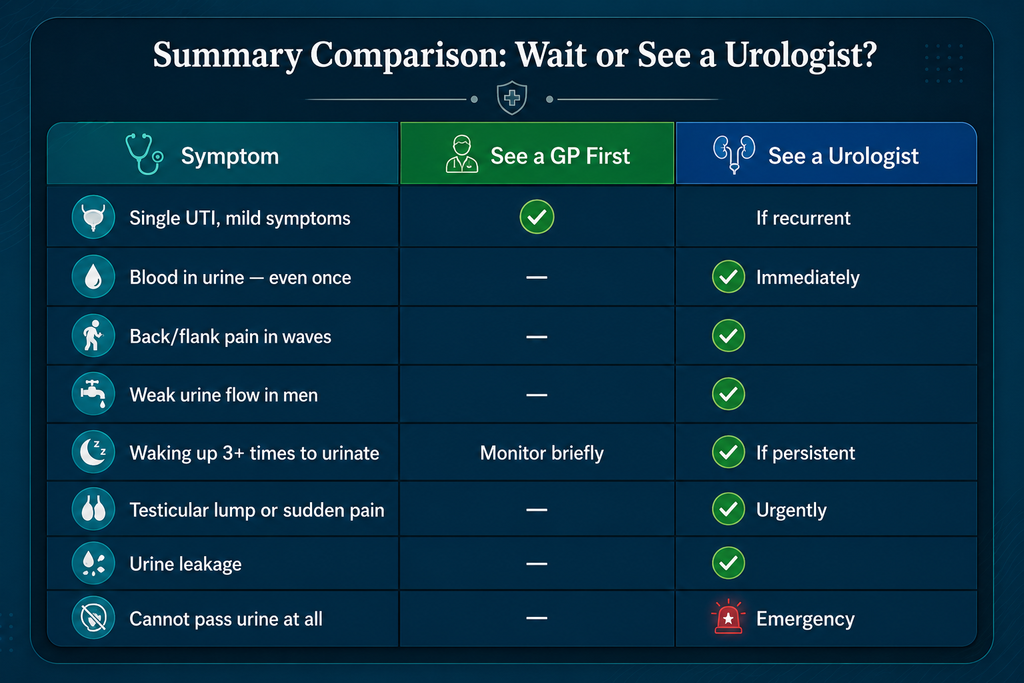
Summary Comparison: Wait or See a Urologist?
Frequently Asked Questions
Q1. I have burning when I pass urine but it’s improving — do I still need to see a doctor?
If it was a single, mild episode that fully resolved, a GP visit is reasonable. But if you’re a man, if it recurs, if you have fever or back pain alongside it, or if antibiotics haven’t fully worked — see a urologist in Jaipur rather than waiting for it to happen again.
Q2. Can kidney stones go away without treatment?
Small stones (under 5–6 mm) often pass on their own with adequate fluid intake and pain management. However, this needs to be confirmed by an ultrasound or CT scan — you can’t tell stone size or location without imaging. Larger stones, stones causing blockage, or stones with infection require proper urological treatment.
Q3. My father is 60 and wakes up 3–4 times at night to urinate. Is this normal at his age?
It’s common — but it’s not something that must be accepted. Nocturia at that frequency usually indicates BPH, overactive bladder, or another treatable condition. A urology consultation in Jaipur will identify the cause and offer effective treatment options that can significantly improve his sleep and quality of life.
Q4. I’m a woman — do I need a urologist or a gynaecologist for my urinary problems?
Both can help depending on the condition. For recurrent UTIs, urinary incontinence, overactive bladder, or kidney problems — a urologist is the right specialist. For issues related to the uterus, ovaries, or vagina — a gynaecologist. Many women have overlapping conditions and may need input from both.
Q5. Is urology treatment very expensive in Jaipur?
Costs vary. Many conditions — BPH, UTI, small kidney stones — are managed with medication and lifestyle changes, which are very affordable. Procedures like ureteroscopy for kidney stones or TURP for BPH are available at both government hospitals (SMS Hospital, RUHS) and private centres in Jaipur. A good urology specialist will always discuss all your options, including costs, before recommending a procedure.
Key Takeaways
- Blood in urine is the single most important symptom to never ignore — see a urologist the same week, even if it appeared only once
- Kidney stones are very common in Rajasthan’s climate — back pain in waves, with nausea or blood in urine, needs urgent evaluation
- Prostate symptoms in men over 45 — weak flow, straining, incomplete emptying — are treatable, not just “ageing”
- Frequent night urination reduces quality of life but responds well to treatment when properly diagnosed
- Testicular lumps or sudden testicular pain require same-week or emergency care, respectively
- Urinary leakage affects millions but is rarely discussed — effective solutions exist
- Ignoring symptoms doesn’t make them go away. Early evaluation means simpler treatment and better outcomes
Take the First Step — Book a Urology Consultation
If you recognise any of the 7 signs above in yourself or a family member, don’t put it off any longer.
UROWALA is a patient-focused urology platform designed to make quality urological care accessible, understandable, and approachable — for patients across Jaipur, Rajasthan, and beyond.
📍 Serving patients from Jaipur — including Mansarovar, B2 Bypass, GP Colony, Vaishali Nagar, Civil Lines, and across Rajasthan
📱 Teleconsultation available — get a specialist opinion without travel
🌐 Visit urowala.com to book your consultation or learn more
*Your kidneys, bladder, and prostate work every single day for you. Give them the attention they deserve.*
About the Author
Dr. Mohit Sharma is an MCh Urology specialist from AIIMS and founder of UROWALA. His areas of interest include kidney stone disease, prostate disorders, urinary tract conditions, men’s health, and minimally invasive urological procedures. Through UROWALA, he aims to make urological healthcare easier to understand and more accessible for patients.
*This article is for general patient education only and does not substitute for a medical consultation. Please consult a qualified urologist for any symptoms or concerns.*