

Introduction
As men age, enlargement of the prostate gland becomes increasingly common. Many men in Jaipur and across Rajasthan begin experiencing urinary symptoms that quietly affect their sleep, work, travel, and overall quality of life — often for years before seeking treatment.
One of the most advanced treatments available today is HoLEP (Holmium Laser Enucleation of the Prostate), a minimally invasive laser surgery that can effectively treat enlarged prostates of almost any size, including very large glands that were traditionally difficult to manage.
What Is an Enlarged Prostate?
The prostate is a gland located just below the bladder, surrounding the urinary passage (urethra). With age, the prostate may gradually enlarge — a condition known as Benign Prostatic Hyperplasia (BPH).
BPH is non-cancerous and affects millions of men worldwide. As the prostate grows, it can compress the urethra and obstruct normal urine flow.
Common Symptoms of Enlarged Prostate
Men with BPH may experience:
- Weak urine stream
- Difficulty starting urination
- Frequent urination
- A sense of urgency to urinate
- Waking up multiple times at night to urinate (nocturia)
- A feeling of incomplete bladder emptying
- Urinary retention (inability to pass urine at all)
These symptoms often develop gradually over years, which is why many men adapt to them silently before finally seeking evaluation.
What Is HoLEP?
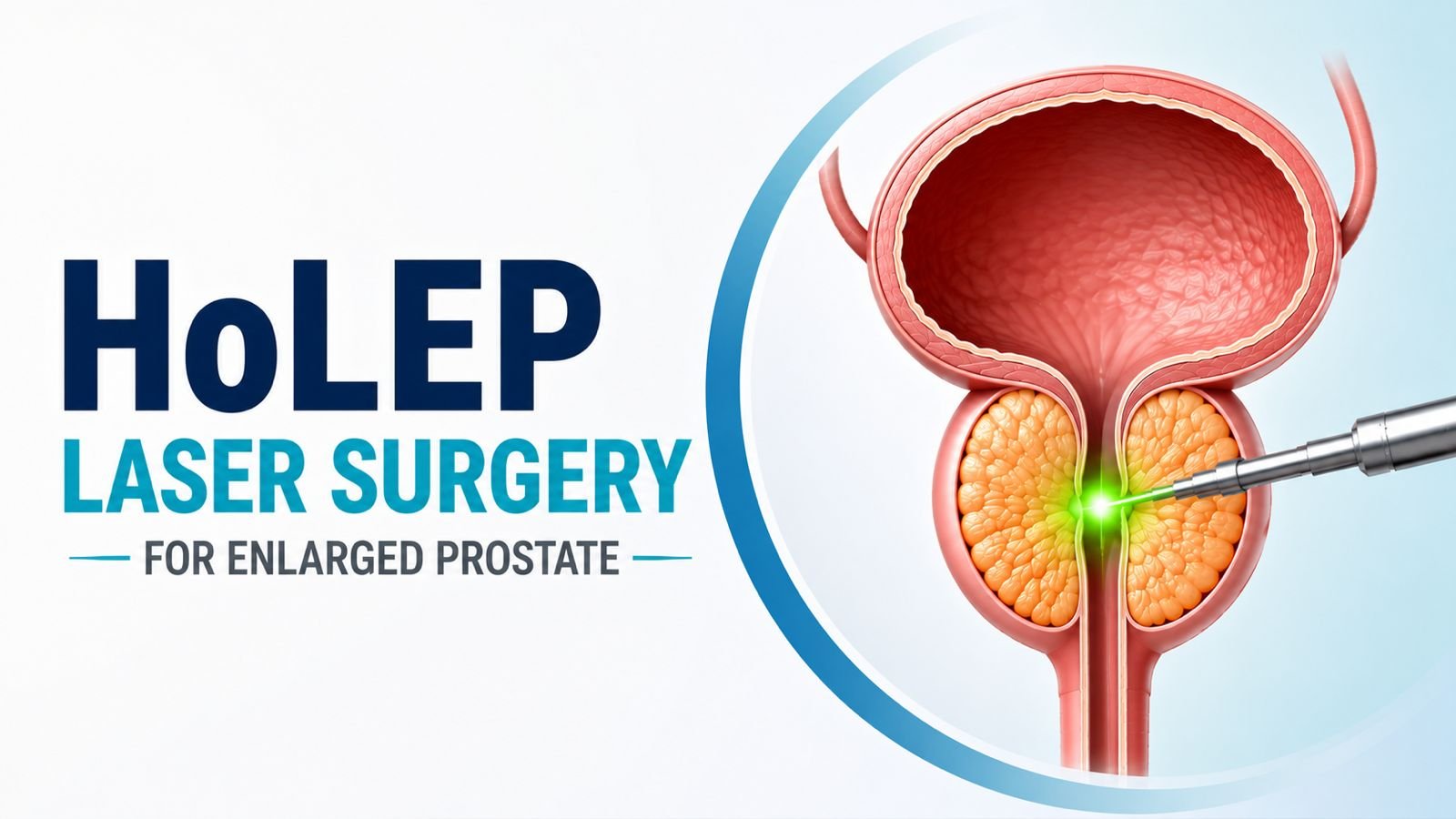
HoLEP (Holmium Laser Enucleation of the Prostate) is a laser procedure used to remove the obstructing prostate tissue that is causing urinary blockage. Instead of cutting through the abdomen, the entire surgery is performed through the natural urinary passage — there are no external incisions at all.
The laser precisely separates the enlarged prostate tissue from its outer capsule, restoring free urine flow.
How Does HoLEP Work?
Step 1: Laser Enucleation
A Holmium laser is used to carefully separate the enlarged prostate tissue from the surrounding capsule.
Step 2: Tissue Removal
The separated tissue is pushed into the bladder for temporary storage.
Step 3: Morcellation
A specialized instrument breaks the tissue into smaller fragments and safely removes it from the bladder.
No external cuts are required at any stage of the procedure.
Who May Need HoLEP Surgery?
HoLEP may be recommended for men with:
- Moderate to severe urinary symptoms affecting daily life
- Large prostate glands
- Recurrent episodes of urinary retention
- Recurrent urinary tract infections related to poor bladder emptying
- Bladder stones caused by BPH
- Kidney function deterioration caused by prostate obstruction
- Failure to respond adequately to medical (tablet-based) treatment
Advantages of HoLEP
Effective for Large Prostates Unlike some other surgical options, HoLEP can treat very large prostate glands effectively — a key advantage for patients who have delayed treatment for years.
Minimal Blood Loss The laser seals blood vessels as it works, making HoLEP particularly useful for patients on blood-thinning medications, after appropriate pre-operative evaluation.
Short Hospital Stay Many patients are discharged within 24–48 hours of surgery.
Durable Results Long-term studies show excellent outcomes with low rates of needing repeat surgery.
Tissue Available for Analysis The removed prostate tissue can be sent for histopathological (laboratory) examination, which adds an additional layer of diagnostic safety compared to procedures that vaporize tissue without sending it for testing.
What Happens After Surgery?
A urinary catheter is usually placed temporarily to allow the bladder and urethra to heal. Most patients notice:
- A stronger urine stream
- Better and more complete bladder emptying
- Overall improvement in urinary symptoms
Mild burning or blood-tinged urine may occur initially and usually improves steadily over the following days.
Recovery After HoLEP
First Few Days Increased fluid intake is encouraged, and mild urinary urgency may be noticed as the bladder adjusts.
First Few Weeks Urinary flow improves progressively, and most routine daily activities can be resumed.
Long-Term Many patients experience significant and lasting relief from their urinary symptoms, often describing it as a return to normal urination for the first time in years.
Possible Side Effects and Risks
Like any surgical procedure, HoLEP carries potential risks, which may include:
- Temporary burning during urination
- Mild bleeding
- Urinary urgency
- Temporary stress urinary leakage
- Retrograde ejaculation (dry orgasm)
Most of these complications are temporary and improve with time as healing progresses.
HoLEP vs TURP
| Feature | HoLEP | TURP |
|---|---|---|
| Suitable for large prostates | Yes | Limited |
| Blood loss | Less | More |
| Hospital stay | Short | Short |
| Durability | Excellent | Excellent |
| Tissue available for testing | Yes | Yes |
Both HoLEP and TURP (Transurethral Resection of the Prostate) are effective, well-established procedures. However, HoLEP has become increasingly popular for larger prostate glands and for patients seeking reduced blood loss during surgery.
HoLEP Availability and Prostate Care in Jaipur
HoLEP requires specialized laser equipment and surgical training, and availability may vary between centers in Jaipur. When considering enlarged prostate surgery, it is worth discussing with your urologist:
- Whether HoLEP is available and appropriate for your specific prostate size and health profile
- Government facilities such as SMS Hospital, Jaipur and RUHS Hospital, which provide urology services for BPH management
- Ayushman Bharat coverage for prostate surgery — eligibility and empanelled procedures should be confirmed directly with your treating hospital
- Post-operative medications, which are often available affordably through Jan Aushadhi Kendra outlets across the city
Frequently Asked Questions (FAQs)
What is HoLEP surgery?
HoLEP (Holmium Laser Enucleation of the Prostate) is a laser-based surgical procedure that removes obstructing prostate tissue through the natural urinary passage, without any external incisions, to relieve urinary blockage caused by an enlarged prostate.
HoLEP सर्जरी क्या है? HoLEP (होल्मियम लेजर एन्युक्लिएशन ऑफ प्रोस्टेट) एक लेजर आधारित सर्जिकल प्रक्रिया है जो प्राकृतिक यूरिनरी पैसेज के माध्यम से बढ़ी हुई प्रोस्टेट के ऊतक को हटाती है, बिना किसी बाहरी चीरे के, जिससे बढ़ी हुई प्रोस्टेट के कारण होने वाली रुकावट दूर होती है।
Is HoLEP better than TURP?
Both are effective procedures with excellent durability. HoLEP offers advantages for larger prostates and generally causes less blood loss, while TURP remains a well-established option, particularly for smaller to moderately sized glands.
क्या HoLEP, TURP से बेहतर है? दोनों ही प्रभावी प्रक्रियाएं हैं और उत्कृष्ट durability देती हैं। HoLEP बड़ी प्रोस्टेट के लिए फायदेमंद है और आमतौर पर कम रक्तस्राव होता है, जबकि TURP छोटी से मध्यम आकार की प्रोस्टेट के लिए एक अच्छी तरह स्थापित विकल्प बना हुआ है।
How long does HoLEP recovery take?
Most patients are discharged within 24–48 hours, with progressive improvement in urinary flow over the following weeks and significant long-term symptom relief.
HoLEP रिकवरी में कितना समय लगता है? अधिकतर मरीज 24-48 घंटों के भीतर डिस्चार्ज हो जाते हैं, और अगले कुछ हफ्तों में पेशाब के प्रवाह में क्रमिक सुधार होता है, साथ ही दीर्घकालिक लक्षणों में महत्वपूर्ण राहत मिलती है।
Can HoLEP treat large prostates?
Yes. One of HoLEP’s key advantages is its effectiveness for very large prostate glands, which can be more challenging to treat with some other surgical techniques.
क्या HoLEP बड़ी प्रोस्टेट का इलाज कर सकता है? हाँ। HoLEP का एक प्रमुख फायदा यह है कि यह बहुत बड़ी प्रोस्टेट ग्रंथियों के लिए भी प्रभावी है, जिनका इलाज कुछ अन्य सर्जिकल तकनीकों से करना अधिक चुनौतीपूर्ण हो सकता है।
What are the side effects of HoLEP?
Possible side effects include temporary burning during urination, mild bleeding, urinary urgency, temporary stress urinary leakage, and retrograde ejaculation. Most of these are temporary and improve with time.
HoLEP के दुष्प्रभाव क्या हैं? संभावित दुष्प्रभावों में पेशाब के दौरान अस्थायी जलन, हल्का रक्तस्राव, पेशाब की तीव्र इच्छा, अस्थायी स्ट्रेस यूरिनरी लीकेज, और रेट्रोग्रेड इजेकुलेशन शामिल हैं। इनमें से अधिकतर अस्थायी होते हैं और समय के साथ ठीक हो जाते हैं।
Who is a candidate for HoLEP surgery?
Men with moderate to severe urinary symptoms, large prostate glands, recurrent urinary retention, recurrent infections, bladder stones due to BPH, or those who have not responded adequately to medications may be candidates for HoLEP, following evaluation by a urologist.
HoLEP सर्जरी के लिए कौन उपयुक्त उम्मीदवार है? मध्यम से गंभीर पेशाब संबंधी लक्षण, बड़ी प्रोस्टेट ग्रंथि, बार-बार यूरिनरी रिटेंशन, बार-बार इन्फेक्शन, BPH के कारण ब्लैडर स्टोन, या दवाओं से पर्याप्त सुधार न होने वाले पुरुष यूरोलॉजिस्ट की जांच के बाद HoLEP के लिए उम्मीदवार हो सकते हैं।
When Should You Consult a Urologist?
Seek evaluation if you have:
- Weak urine stream
- Frequent urination, especially at night
- Difficulty emptying the bladder completely
- Recurrent episodes of urinary retention
- Blood in urine
- Recurrent urinary infections
Early treatment may prevent complications affecting the bladder and kidneys over time.
Key Takeaway
HoLEP is one of the most advanced and effective treatments available for enlarged prostate (BPH). It offers excellent urinary outcomes, minimal blood loss, and durable long-term results, especially for men with large prostate glands. For patients struggling with urinary symptoms despite medications, HoLEP may provide lasting relief and a meaningful improvement in quality of life.
This article is written for general patient education and does not replace an in-person consultation. For evaluation of enlarged prostate symptoms or to discuss whether HoLEP is right for you, please consult a qualified urologist.
About the Author: Dr. Mohit Sharma is an MCh Urology specialist trained at AIIMS, with clinical expertise in prostate disorders, men’s health, and minimally invasive urological procedures. He is the founder of UROWALA, a urology patient education and consultation platform based in Jaipur, Rajasthan.