

Kidney stones affect a significant proportion of the population in Rajasthan — and Jaipur is no exception. Hard water, intense heat, and dietary patterns common in this region all raise the risk of stone formation. When a stone gets stuck in the ureter (the tube connecting kidney to bladder), it causes intense, wave-like pain that sends thousands of patients in Jaipur to emergency rooms every year.
For most ureteral stones that cannot pass on their own, Ureteroscopic Laser Lithotripsy (URSL) is the preferred surgical solution recommended by international urology guidelines. It is safe, precise, stitch-free, and most patients go home the same day. This guide explains everything you need to know in plain language.
Quick Summary: URSL uses a thin flexible or semi-rigid telescope inserted through the natural urinary passage (no cuts on the skin) to reach a stone inside the ureter or kidney. A laser then breaks it into fine powder or small fragments that pass out naturally with urine.
What Exactly Is URSL?
URSL stands for Ureteroscopic Laser Stone Removal (sometimes written as URS-LL for Ureteroscopic Laser Lithotripsy). It is a minimally invasive endoscopic procedure performed entirely through the body’s natural urinary channel — no cuts, no stitches on the skin.
A thin, pencil-sized instrument called a ureteroscope is passed through the urethra → bladder → ureter until it reaches the stone. Through the same instrument, a thin laser fibre is advanced to touch the stone, and high-energy laser pulses shatter it.
The laser most commonly used is the Holmium:YAG laser — an internationally established and highly safe energy source for stone fragmentation. Some centres now also use the newer Thulium Fibre Laser (TFL), which is even more efficient.
> 🔬 Why “Laser” Matters: Unlike older mechanical forceps (which could push a stone back up), a laser vaporises the stone in place. This is particularly important for hard stones — calcium oxalate monohydrate stones, common in Rajasthan due to high oxalate intake from spinach, tomatoes, and bajra — which resist mechanical fragmentation.
Which Stones Need URSL?
Not every kidney stone needs surgery. Many stones smaller than 5 mm pass on their own with adequate hydration and medications. However, surgery becomes necessary when:
- The stone is larger than 10 mm and unlikely to pass naturally
- The stone is causing persistent severe pain despite medication
- There is associated fever or infection (a urological emergency)
- The stone is causing obstruction and damaging the kidney
- The patient is a pilot, driver, or professional who cannot afford a sudden stone attack
- The stone has not passed after 4–6 weeks of conservative management
According to the EAU (European Association of Urology) guidelines, URSL is the recommended first-line treatment for ureteral stones between 10 mm and 20 mm, and is often preferred for lower ureteral stones regardless of size.
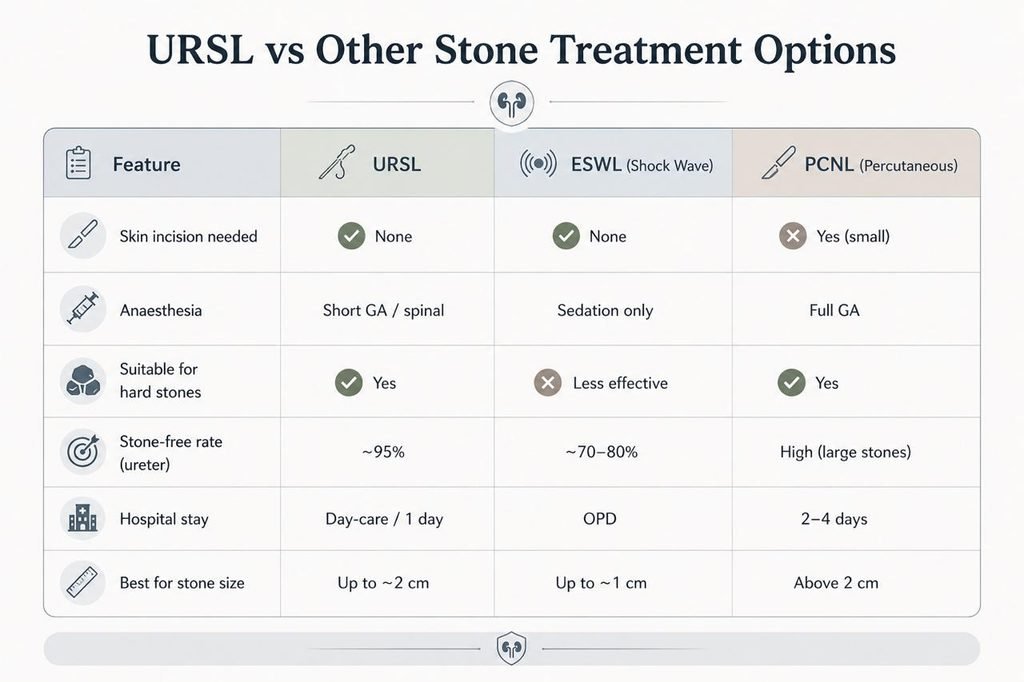
URSL vs Other Stone Treatment Options
What Happens During URSL — Step by Step
Understanding the procedure helps reduce anxiety before the operation. Here is what typically happens:
Step 1 — Pre-operative evaluation
A urine culture, blood tests, ultrasound, and usually a non-contrast CT KUB (kidney-ureter-bladder) are done to confirm the stone’s exact size and position. An active urine infection must be treated before URSL to prevent sepsis.
Step 2 — Anaesthesia
URSL is performed under spinal or short general anaesthesia. The procedure typically lasts 30–60 minutes depending on stone burden and position.
Step 3 — Scope insertion
The urologist gently passes the ureteroscope through the urethra and bladder, then carefully advances it up the ureter to reach the stone. A safety guidewire is placed first to protect the ureter.
Step 4 — Laser fragmentation
The laser fibre is passed through the working channel of the scope. Controlled bursts of laser energy fragment the stone into small pieces or dust, which will pass in the urine over the next few days.
Step 5 — Basket retrieval (if needed)
Larger fragments may be extracted with a small basket forceps passed through the scope, rather than left to pass spontaneously.
Step 6 — DJ stent placement
In most cases, a soft double-J (DJ) stent is left in the ureter at the end to keep it open and aid healing. This stent is removed as a short outpatient procedure — usually 2–4 weeks later.
⚠️ About the DJ Stent: The DJ stent can cause some discomfort — mild burning while passing urine, increased frequency, or occasional flank ache. These are normal side effects and resolve completely after stent removal. Do not remove or pull the stent yourself. It has a retrieval string or is removed by cystoscopy in clinic.
Recovery After URSL
Most patients return home within 24 hours of URSL. Recovery is generally smooth and quick:
- First 24–48 hours: Expect pink-tinged urine (due to blood from the procedure) — this is normal. Drink plenty of water (2.5–3 litres/day).
- Pain: Mild ureteral or bladder discomfort is common, well managed with standard pain medications (like diclofenac or paracetamol).
- Returning to work: Desk jobs — 2 to 3 days. Physical labour — 1 to 2 weeks.
- Stent removal: Scheduled at 2–4 weeks as a short clinic procedure. Many patients report significant relief immediately after stent removal.
- Follow-up ultrasound: Done 4–6 weeks later to confirm the kidney is stone-free and draining well.
💧 Jaipur-Specific Advice: Given Jaipur’s extreme summer heat (May–July regularly exceeds 43°C), adequate fluid intake is critical both for recovery and for preventing stone recurrence. Hard water consumed in many parts of the city is high in calcium and magnesium — consider using a water filter, and discuss dietary modifications with your urologist.
Is URSL Safe? Understanding the Risks
URSL is one of the most studied and safest urological procedures available. Serious complications are uncommon. However, as with any surgical procedure, patients should be aware of the following:
- Urinary tract infection (UTI): Preventable with pre-operative antibiotics; treatable if it occurs
- Ureteral injury or perforation: Rare (~1–2%), usually managed conservatively with stenting
- Incomplete stone clearance: Residual fragments may occasionally require a second procedure
- Ureteral stricture (long-term): Very uncommon; more likely in repeated procedures
- Stent-related discomfort: Common but temporary; resolves after stent removal
Overall, URSL carries a stone-free rate of approximately 90–95% for ureteral stones and a low major complication rate — making it the globally recommended standard of care.
Frequently Asked Questions
क्या URSL surgery में कोई चीरा लगता है? (Is there any cut in URSL?)
नहीं। URSL में शरीर पर कोई कट या टांका नहीं लगता। उपकरण प्राकृतिक मूत्र मार्ग (urethra) से अंदर जाता है।
*No. URSL does not require any skin incision. The scope is passed through the natural urinary passage.*
How long does the procedure take?
Most URSL procedures are completed in 30 to 60 minutes, depending on the number, size, and hardness of the stone. You are generally kept in observation for a few hours post-procedure before discharge.
Will I feel the stone pieces passing after surgery?
If the stone is dusted into very fine powder, most patients experience no significant passage. If broken into small fragments, you may notice gritty or small sandy pieces in the urine over 1–2 weeks. This is entirely normal.
Can URSL be done for kidney stones too, or only ureteral stones?
Yes. Flexible ureteroscopy — using a bending, steerable scope — can reach stones inside the kidney itself. This procedure (Flexible URS or f-URS / RIRS) is used for kidney stones up to about 2 cm. It follows the same laser-based principle as standard URSL.
What precautions should I take after URSL to prevent stones from coming back?
Stone recurrence is a genuine concern — 50% of patients form another stone within 10 years without preventive measures. Key steps: drink 2.5–3 litres of water daily, reduce salt intake, limit spinach/tomatoes/chocolate if your stone is calcium oxalate, and ask your urologist about a 24-hour urine metabolic evaluation to identify your specific risk factors.
Is URSL available under Ayushman Bharat / Jan Aushadhi schemes in Jaipur?
URSL is listed under the Ayushman Bharat PM-JAY package for urinary tract stone procedures. Several empanelled hospitals offer this procedure under the scheme. Confirm your eligibility and empanelment before scheduling.
When to Seek Urgent Care
🚨 Go to the Emergency Department Immediately If:
- Severe, uncontrolled flank/abdominal pain despite pain medications
- Fever (above 38°C) with chills — this may indicate pyonephrosis, an infected obstructed kidney and a urological emergency
- Complete inability to pass urine
- Heavy blood clots in the urine after URSL
The Bottom Line
URSL (Ureteroscopic Laser Lithotripsy) represents one of the most significant advances in urological surgery over the past two decades. For the large number of patients in Jaipur and across Rajasthan who suffer from ureteral and kidney stones, it offers a highly effective, safe, and minimally invasive solution — without the recovery burden of open surgery.
If you or someone in your family has been diagnosed with a kidney or ureteral stone, speak to a qualified urologist to understand whether URSL, ESWL, PCNL, or conservative management is the right path based on your stone’s characteristics.
Tags: URSL Jaipur · Kidney Stone Surgery · Laser Lithotripsy · Ureteral Stone · Jaipur Urology · पथरी का इलाज · Rajasthan Kidney Stone · DJ Stent · Holmium Laser · Ayushman Bharat Jaipur
Medical Disclaimer: This article is intended for patient education and general information only. It does not constitute personalised medical advice, diagnosis, or a treatment recommendation. Every patient’s situation is unique — always consult a qualified urologist for evaluation and guidance specific to your condition.