

Introduction
If you or someone in your family has been told that a kidney stone is “too large to pass on its own,” your doctor may have recommended a surgery called PCNL. This name can sound intimidating, especially if you have never heard of it before.
The good news is that PCNL is a well-established, minimally invasive procedure that has helped millions of patients get rid of large and complex kidney stones — without requiring a large open cut on the abdomen.
This article explains everything you need to know about PCNL surgery in simple, straightforward language: what it means, why it is done, how the procedure works, what recovery looks like, and when you should consult a urologist. Whether you are a patient, a family member, or simply researching your options for kidney stone treatment in Jaipur or anywhere in Rajasthan, this guide is written with you in mind.
What Is PCNL?
PCNL stands for Percutaneous Nephrolithotomy — a minimally invasive surgical technique used to remove large or complex kidney stones.
Instead of making a large incision in the abdomen the way traditional open surgery does, the surgeon creates a small puncture (less than 1 cm) in the skin of the patient’s back. Through this tiny opening, a thin instrument called a nephroscope is passed directly into the kidney to break and remove the stone.
The term “percutaneous” simply means “through the skin,” and “nephrolithotomy” means “removal of a stone from the kidney.”
PCNL Full Form in Medical
The PCNL full form in medical terminology is:
Percutaneous Nephrolithotomy
Percutaneous = Through the skin (a small puncture, no large cut)
Nephro = Related to the kidney
Lithotomy = Surgical removal of a stone
So in plain language, PCNL = *removing a kidney stone through a small hole in the back.
This is important to know, because many patients come in having searched for “PCNL full form” or “PCNL full form in medical” and worry the surgery is something more complex than it actually is. It is a targeted, controlled procedure — not open surgery.
Why Is PCNL Surgery Done?
PCNL surgery is recommended when a kidney stone cannot be treated by simpler methods. The main reasons your urologist might suggest PCNL include:
- Stone size greater than 2 cm — Stones this large rarely pass on their own and are often too large for laser (URSL/RIRS) treatment
- Staghorn stones — Large, branching stones that fill the entire inner space of the kidney
- Stones in abnormal kidney anatomy — Including horseshoe kidneys or kidneys with abnormal drainage
- Previous treatment failures — If shockwave lithotripsy (ESWL) or laser procedures have not been successful
- Obstructing stones causing kidney damage — If the stone is blocking urine flow and threatening kidney function
- Multiple large stones — Several stones clustered together that need to be cleared in one sitting
- Hard stones — Some stone types (like cystine or calcium oxalate monohydrate) are very hard and resistant to laser energy; PCNL allows direct removal
Symptoms That May Mean You Need PCNL
Not every kidney stone requires surgery. But certain symptoms and signs suggest that a larger stone may be present — and that PCNL might be the recommended treatment:
- Severe, recurring pain in the back or side (flank pain) that is not fully controlled by pain medications
- Blood in the urine (urine appears pink, red, or brown)
- Recurrent urinary infections despite antibiotic treatment — often a sign of an underlying stone harbouring bacteria
- Reduced urine output or a feeling that urine is not flowing properly
- Nausea and vomiting associated with severe pain episodes
- Fever with chills — a sign of possible kidney infection linked to a stone blockage (this is an urgent situation)
- A stone detected on ultrasound or CT scan that is too large to pass or be treated with simpler methods
If you are experiencing these symptoms, please consult a qualified urologist rather than waiting for the stone to pass on its own.
Who Is a Good Candidate for PCNL?
PCNL is suitable for most healthy adults who have been diagnosed with large kidney stones. Your urologist will assess the following before recommending PCNL:
You are likely a good candidate if you have:
- A kidney stone larger than 2 cm
- A stone that has not responded to other treatments
- A staghorn or partial staghorn stone
- A stone associated with repeated infections or obstruction
Your doctor will also evaluate:
- Your overall health and fitness for anaesthesia
- Blood tests (complete blood count, kidney function, clotting profile)
- Urine culture (to rule out active infection before surgery)
- Imaging — usually a non-contrast CT scan (NCCT KUB) to map the stone accurately
Relative cautions (not absolute contraindications):
- Blood thinning medications (may need to be paused before surgery)
- Severe obesity (may need technical modifications)
- Uncorrected bleeding disorders
- Active urinary tract infection (surgery is deferred until infection is treated)
How Is the PCNL Procedure Performed? (Step-by-Step)
Understanding what happens during PCNL can make the experience much less stressful. Here is a step-by-step overview:
Step 1 — Anaesthesia
PCNL is performed under general anaesthesia (you will be asleep and will feel nothing). In select cases, spinal anaesthesia may be used.
Step 2 — Positioning
You will be positioned lying face-down (prone position) on the operating table. This gives the surgeon clear access to the back of the kidney.
Step 3 — Ureteric catheter placement
A small tube is first placed through the urethra and bladder into the ureter (the tube connecting kidney to bladder). This helps the surgeon visualise the kidney collecting system using X-ray or fluoroscopy.
Step 4 — Puncture and tract creation
Under X-ray guidance, the surgeon makes a small puncture (about 5–10 mm) in the skin of your back, aiming precisely for the stone-bearing part of the kidney. A series of dilators is then used to widen this tract just enough to allow the nephroscope to pass through.
Step 5 — Stone visualisation and fragmentation
A nephroscope (a thin, rigid telescope with a camera) is passed through the tract into the kidney. The stone is visualised directly. If the stone is large, it is broken into smaller pieces using laser energy (holmium laser) or pneumatic energy (a small jackhammer-like device called a pneumatic lithoclast).
Step 6 — Stone removal
The stone fragments are removed through the nephroscope using forceps or a suction device. The surgeon confirms that the kidney is as “stone-free” as possible, often checking with X-ray imaging.
Step 7 — Nephrostomy tube placement
At the end of the procedure, a thin drainage tube (nephrostomy tube) is left in place through the puncture to help the kidney drain properly and heal. This tube is usually removed after 24–48 hours.
Step 8 — Ureteric stent
In many cases, a small internal plastic tube called a DJ stent is placed inside the ureter to keep it open during healing. This stent is usually removed in a clinic visit 2–4 weeks later.
The surgery typically takes 60–120 minutes depending on stone complexity.
What Happens During Hospital Stay?
Most patients who undergo PCNL stay in hospital for 2–4 days. Here is what to expect:
- Day of surgery: You will be taken to the recovery room after the procedure. Once stable, you are shifted to your ward. The nephrostomy tube and a urinary catheter (Foley catheter) will be in place.
- Day 1 after surgery: Your urine output, blood pressure, and pain will be monitored. You will be encouraged to take sips of water and liquid diet. Most patients experience mild to moderate back pain and some blood-tinged urine — both are expected.
- Day 2: Blood tests are repeated to check haemoglobin and kidney function. A check X-ray or ultrasound may be done to confirm adequate stone clearance. If drainage is satisfactory, the nephrostomy tube may be removed (called “tubeless PCNL exit”).
- Day 3–4: Most patients are comfortable enough to go home. Instructions are given regarding diet, activity restrictions, and the follow-up appointment.
PCNL Recovery Timeline
Recovery after PCNL is significantly faster than open kidney surgery. Here is a general timeline:
Day 1 — Immediately After Surgery
- You will wake up in the recovery area with a nephrostomy tube and urinary catheter in place
- Mild to moderate flank pain — managed with prescribed pain medications
- Urine may appear blood-tinged (this is expected)
- Light liquids allowed once fully awake
Week 1 — Home Rest
- Return home after 2–4 days
- Rest at home; avoid lifting heavy objects or strenuous activity
- Some mild discomfort at the puncture site is normal
- Drink plenty of water (2.5–3 litres per day) unless advised otherwise
- Take all prescribed medications
Week 2 — Gradual Improvement
- Most patients feel significantly better
- Light indoor activity is usually fine
- The DJ stent (if placed) may cause mild discomfort or frequent urination — this settles on its own
- Avoid riding two-wheelers, heavy lifting, and vigorous exercise
Week 4 — Stent Removal
- A clinic visit is usually scheduled to remove the DJ stent (a quick outpatient procedure, takes less than 5 minutes with local or no anaesthesia)
- Most patients return to desk jobs or light work by this time
Week 6 — Full Recovery
- A CT scan or ultrasound is done to confirm stone clearance
- Most patients have fully recovered and resumed normal physical activity
- Further dietary and lifestyle advice is given to prevent stone recurrence
Benefits of PCNL Surgery
PCNL has several advantages over older, more invasive approaches to kidney stone removal:
- No large external cut — Only a small 1 cm puncture in the back
- High stone clearance rates — Among the highest of any kidney stone procedure, especially for large stones
- Suitable for complex situations — Works for staghorn stones, multiple stones, or previous treatment failures
- Shorter hospital stay — Usually 2–4 days, compared to 7–10 days for open surgery
- Less post-operative pain — Compared to open surgery
- Faster return to normal life — Most patients resume light activity within 2 weeks
- Single sitting clearance — Large stone burden can often be fully cleared in one procedure
- Avoids long-term stone accumulation — Removes stone completely rather than breaking it into fragments that need to pass
Possible Risks and Side Effects
Like all surgical procedures, PCNL carries some risks. Your surgeon will discuss these with you before the procedure. Being informed helps you make a confident decision.
Common (expected, usually temporary):
- Blood-tinged urine for a few days
- Mild pain or discomfort at the puncture site
- Temporary urinary urgency or frequency (especially if a stent is placed)
- Low-grade fever in the first 24 hours
Less common:
- Bleeding requiring blood transfusion (approximately 1–5% of cases)
- Urinary tract infection or fever (addressed with antibiotics)
- Incomplete stone clearance — requiring a second procedure (called “relook PCNL”)
- Injury to surrounding structures (rare with experienced surgeons)
Rare but serious:
- Injury to adjacent organs (pleura/lung, bowel, spleen, liver) — risk is minimised by careful surgical planning and imaging guidance
- Persistent bleeding requiring angioembolisation (a non-surgical procedure to seal a bleeding vessel)
- Sepsis — rare, but emphasises the importance of treating infections before surgery
Most complications are treatable and the overall safety profile of PCNL is well-established in medical literature. Discussing your individual risk with your urologist allows for personalised counselling.
PCNL vs Laser Kidney Stone Surgery
Patients frequently ask: *”Is laser surgery better than PCNL? Which one is right for me?”*
The honest answer is — it depends on your stone size and position. Both procedures have important roles in kidney stone treatment. Here is a side-by-side comparison:
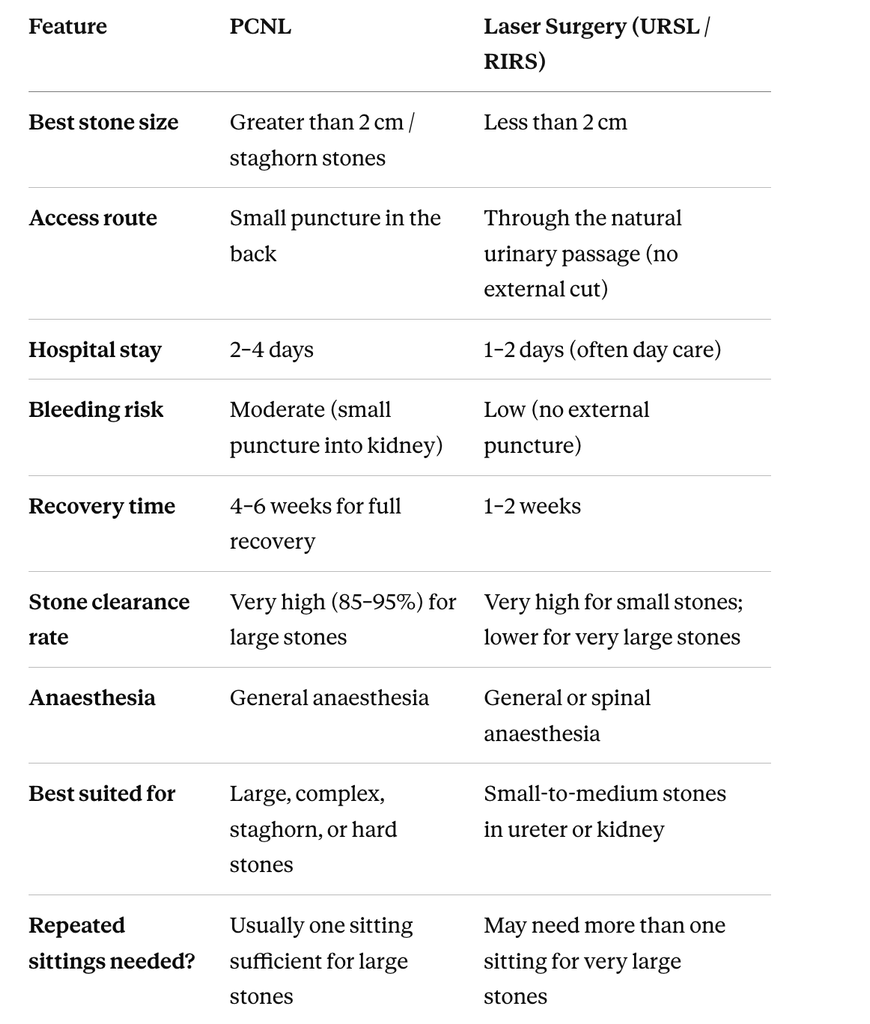
Key takeaway: PCNL and laser surgery are complementary, not competing. Your urologist will recommend the right procedure based on stone size, location, composition, your anatomy, and your overall health.
—
Frequently Asked Questions
1. What is the full form of PCNL?
PCNL stands for Percutaneous Nephrolithotomy. “Percutaneous” means through the skin, “nephro” refers to the kidney, and “lithotomy” means surgical stone removal. In simple terms, PCNL is a procedure to remove large kidney stones through a small puncture in the back.
2. Is PCNL a major surgery?
PCNL is classified as a minimally invasive surgical procedure, not open (major) surgery. It does not involve a large abdominal incision. However, it is performed under general anaesthesia and requires a hospital stay of 2–4 days, so it carries the considerations of any surgical procedure. Compared to open kidney surgery, PCNL is significantly less invasive and recovery is faster.
3. Is PCNL painful?
Most patients experience mild to moderate pain at the puncture site for the first 1–3 days, which is well controlled with prescribed pain medications. There is no large wound to heal, which is why most patients find recovery more manageable than they initially expected. Any discomfort from the internal stent (DJ stent) usually resolves once the stent is removed.
4. How many days does recovery take after PCNL?
Most patients are discharged from hospital within 2–4 days. Light activity can usually be resumed within 1–2 weeks. Full recovery — including return to physically demanding work or exercise — typically takes 4–6 weeks. A follow-up imaging study at 4–6 weeks confirms complete stone clearance.
5. Can kidney stones come back after PCNL?
Yes — PCNL removes the stone that is currently present, but it does not prevent new stones from forming in the future. The likelihood of recurrence depends on dietary habits, water intake, underlying metabolic conditions (such as hyperparathyroidism or high uric acid), and genetic factors. Your urologist may recommend stone composition analysis and metabolic evaluation after PCNL to guide prevention strategies.
6. Is laser surgery better than PCNL?
Neither procedure is universally “better.” Laser surgery (URSL/RIRS) is preferred for smaller stones (usually less than 2 cm) because it avoids any external puncture and has a shorter recovery. PCNL is preferred for larger stones (greater than 2 cm), staghorn stones, or hard stones because it can clear a large stone burden efficiently in one sitting. The right choice depends entirely on your individual stone and health status.
7. How is PCNL different from open kidney surgery?
In open kidney surgery (rarely used today), a 10–15 cm incision is made in the flank or back to access the kidney directly. PCNL achieves the same goal — stone removal from the kidney — through a puncture that is less than 1 cm wide. This means significantly less blood loss, less pain, shorter hospital stay, and faster recovery.
8. What should I eat or avoid before and after PCNL?
Before surgery, you will be asked to fast for at least 6–8 hours. After surgery, your urologist will advise:
- Drink 2.5–3 litres of water per day (unless your kidney function requires a restriction)
- Limit salt, animal protein, and oxalate-rich foods (spinach, tomatoes, nuts) depending on your stone type
- Avoid crash diets, high-protein supplements, and excessive calcium or vitamin C supplementation
- Specific dietary advice should be personalised based on the chemical composition of your stone
When Should You Consult a Urologist?
You should see a urologist as soon as possible if:
- An ultrasound or CT scan has shown a kidney stone larger than 1 cm
- You have been experiencing recurring episodes of severe flank pain
- You have blood in your urine that has not been explained
- You have had recurrent urinary tract infections without an obvious cause
- A previously diagnosed kidney stone is not passing despite adequate fluid intake and medication
- You have a history of kidney stones and are experiencing new symptoms
If you are in Jaipur or the surrounding areas of Rajasthan, consulting an experienced urologist in Jaipur early allows for proper imaging, timely diagnosis, and a personalised treatment plan — before a stone causes serious complications like kidney damage or infection.
Patients who have been referred for kidney stone treatment in Jaipur often ask whether PCNL is their only option. The answer depends on the stone — and an experienced urologist will always discuss all appropriate options with you before recommending surgery.
Key Takeaways
- PCNL full form = Percutaneous Nephrolithotomy — a minimally invasive procedure to remove large kidney stones through a small puncture in the back
- PCNL is the preferred treatment for kidney stones larger than 2 cm, staghorn stones, or stones that have failed other treatments
- The procedure is done under general anaesthesia and involves a hospital stay of 2–4 days
- Recovery typically takes 4–6 weeks for full return to normal activity
- PCNL and laser surgery are complementary — the right choice depends on stone size, location, and patient factors
- Complications exist but are manageable — discuss your individual risk with your surgeon
- Kidney stones can recur after PCNL — dietary and lifestyle changes are important for prevention
- If you have a large or symptomatic kidney stone, consult a urologist early to avoid complications
Ready to Discuss Your Kidney Stone?
If you or a family member has been diagnosed with a large kidney stone, or if you are unsure which treatment is right for your situation, you do not need to figure it out alone.
UROWALA is a patient education and urology consultation platform where you can access evidence-based information and connect with a specialist.
For personalised advice regarding kidney stone surgery in Jaipur, reach out through urowala.com or book a consultation to discuss your imaging and symptoms with a qualified urologist.
About the Author
Dr. Mohit Sharma is an MCh Urology specialist from AIIMS and founder of UROWALA. His areas of interest include prostate disorders, kidney stone disease, urinary tract conditions, men’s health, and minimally invasive urological procedures. Through UROWALA, he aims to make urological healthcare easier to understand and more accessible for patients.
*This article is for educational purposes only and does not constitute medical advice. Please consult a qualified urologist for diagnosis and treatment of your specific condition.*
Keywords targeted: PCNL surgery, PCNL procedure, PCNL full form, PCNL full form in medical, percutaneous nephrolithotomy, kidney stone surgery, large kidney stone treatment, stone removal surgery, kidney stone removal without open surgery, PCNL recovery time, laser vs PCNL kidney stone, urologist in Jaipur, kidney stone treatment in Jaipur, kidney stone surgery in Jaipur