
Sudden, agonizing flank pain is often the first sign that brings patients into my consultation room at Urowala Clinic in Mansarovar. When dealing with kidney and ureteric calculi, fear of surgery and uncertainty about recovery are completely natural. As a practicing urologist, my priority when planning Laser Kidney Stones Surgery in Jaipur is straightforward: pinpoint stone clearance, minimal tissue trauma, and getting you back on your feet quickly without unnecessary cuts.
Living in Rajasthan, our arid climate, harsh summer heat, mineral-heavy tap water, and oxalate-rich dietary habits create an environment where stone formation is exceptionally common. In clinical practice across Jaipur, Nirman Nagar, and Mansarovar, we see recurrence rates touching almost 50% if underlying metabolic and hydration factors are left unaddressed.
Modern endourology has moved far past open surgical incisions. By following established clinical protocols from the European Association of Urology (EAU) and American Urological Association (AUA), we evaluate and treat kidney stones with maximum precision and zero guesswork.
Understanding Laser Kidney Stones Surgery in Jaipur: Symptoms, Causes & Evidence
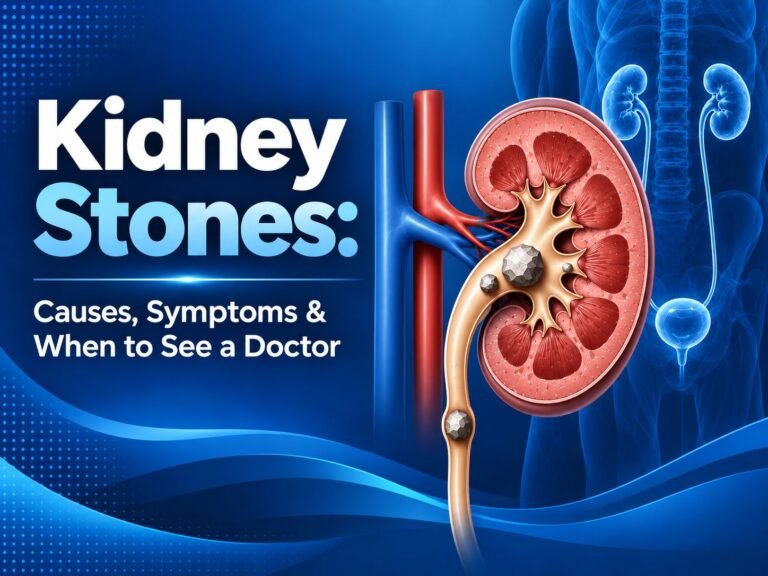
Successful stone surgery begins with an accurate anatomical roadmap. When you visit Urowala Clinic with symptoms suggestive of kidney or ureteric stones, we do not jump straight to surgery. We systematically evaluate stone burden, urinary anatomy, and kidney function through targeted tests:
Key Diagnostic Workup
- Non-Contrast Computed Tomography of Kidneys, Ureters, and Bladder (NCCT KUB): The clinical gold standard. It provides sub-millimeter 3D dimensions, exact location within renal calyces or ureter, and Hounsfield unit (HU) measurements that tell us stone density (hardness).
- High-Resolution Ultrasonography (USG KUB): An essential, radiation-free bedside tool to assess hydronephrosis (swelling in the kidney) and measure renal cortical thickness.
- Serum Creatinine & Blood Urea: Evaluates baseline renal filtration and safeguards against silent, chronic obstruction.
- Routine Urine Microscopy & Culture: Essential to rule out or treat any active UTI prior to laser instrumentation. Operating on infected urine is strictly avoided to prevent urosepsis.
This clear diagnostic picture tells us precisely whether a stone can pass on its own, requires flexible laser dusting, or needs micro-puncture clearance.
Surgical Solutions: Advanced Laser Technologies for Kidney Stones
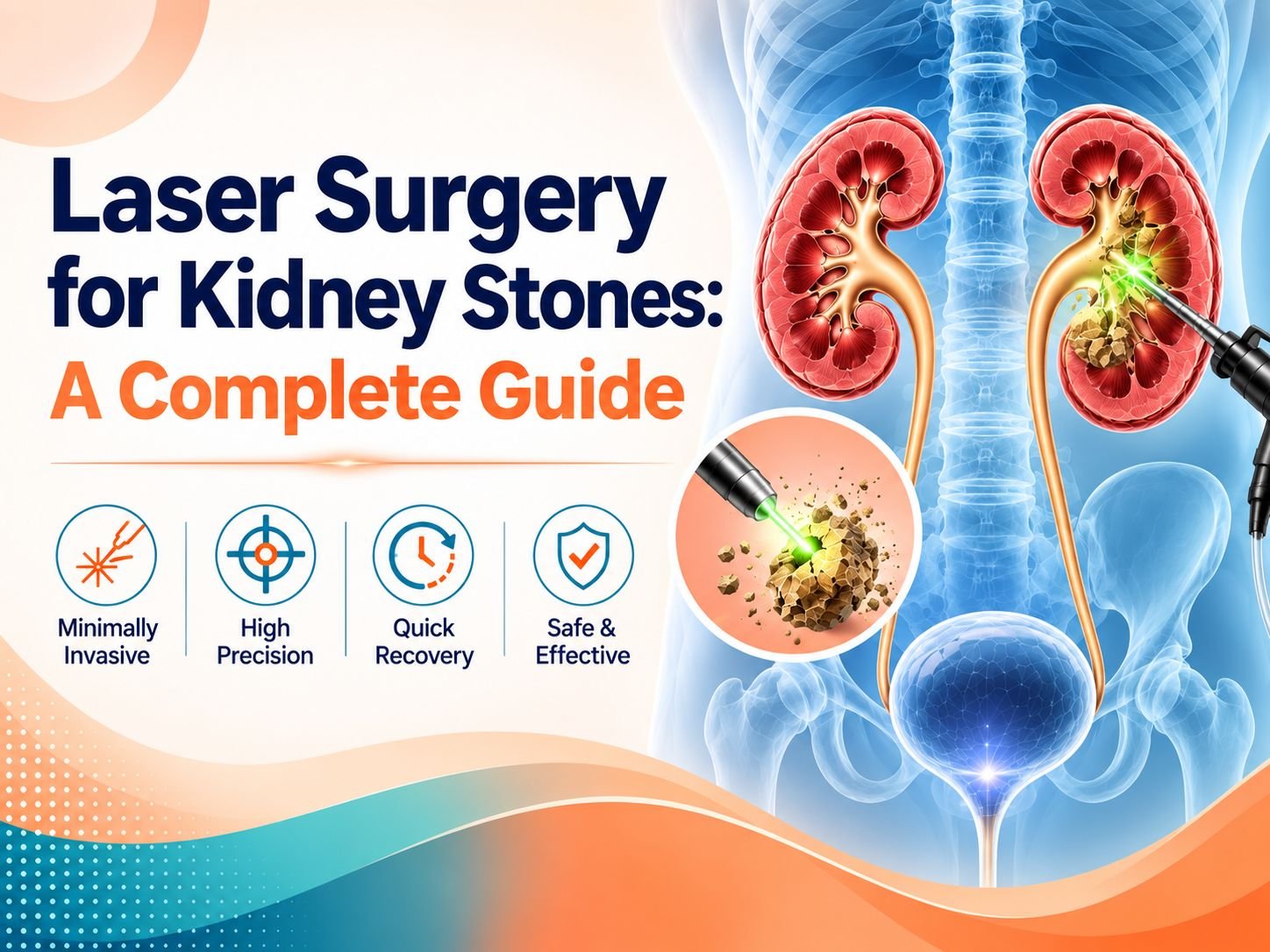
Endourology has rendered large cuts obsolete for stone disease. Depending on stone size, density, and location, we utilize advanced holmium or thulium lasers to fragment or vaporize stones into fine sand.
Retrograde Intrarenal Surgery (RIRS)
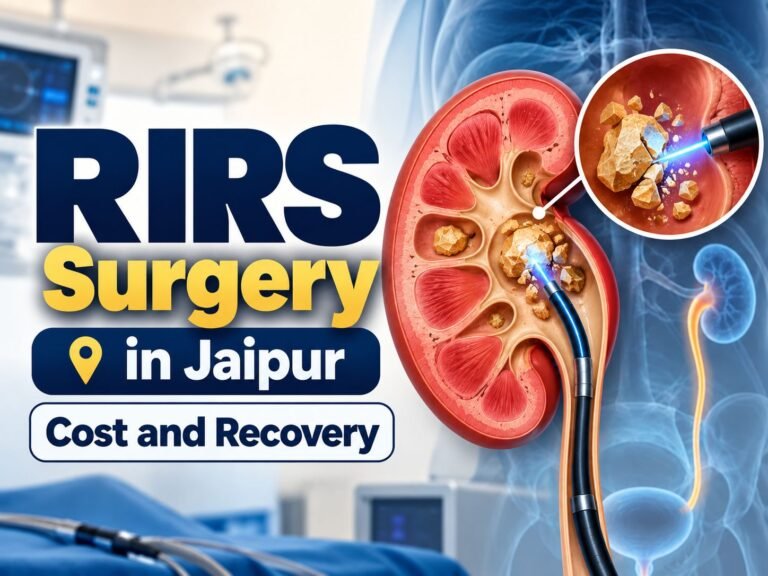
RIRS is our primary approach for kidney stones up to 20 mm. Using an ultra-thin, flexible digital ureteroscope passed naturally through the urinary tract with zero incisions, we reach right into the renal calyces. A fine laser fiber then dusts the stone into washable sand particles.
Mini-PCNL (Percutaneous Nephrolithotomy)
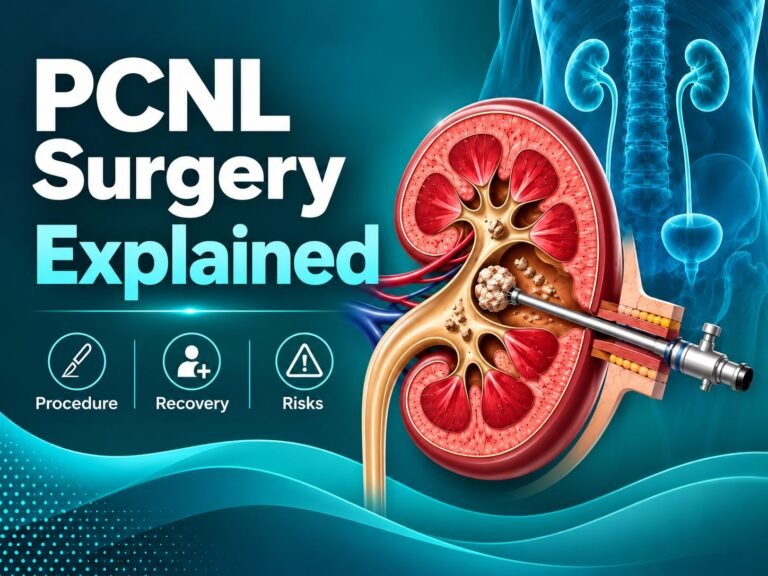
For stones larger than 20 mm, staghorn stones, or complex lower-pole calculi, Mini-PCNL provides excellent clearance. Through a pencil-thin micro-puncture (less than 5 mm) in the flank under fluoroscopic and ultrasound guidance, we break and vacuum out stone fragments in a single sitting.
Ureteroscopic Lithotripsy (URSL)
For stones lodged lower down in the ureter causing acute obstruction and severe colicky pain, semi-rigid URSL allows direct visualization and immediate laser fragmentation, relieving blockages promptly.
Medical Expulsive Therapy (MET)
Surgery is not mandatory for every stone. Small ureteric stones (under 5 to 6 mm) without infection or severe hydronephrosis can often be managed conservatively using targeted alpha-blockers, anti-inflammatory medications, and strict hydration regimens.
Comparing Your Treatment Options
Understanding which procedure suits your condition best is key when planning Laser Kidney Stones Surgery in Jaipur. The table below outlines how these techniques compare in daily clinical practice:
| Procedure | Indications & Stone Sizing | Incision / Surgical Access | Anesthesia | Hospital Stay | Recovery to Desk Work |
|---|---|---|---|---|---|
| Medical Expulsive Therapy (MET) | Ureteral stones < 5-6 mm, non-obstructive | Oral alpha-blockers & hydration protocols | None | Outpatient (0 Days) | Immediate |
| RIRS (Flexible Laser) | Kidney stones up to 20 mm, multiple caliceal stones | Zero incisions via natural urinary tract; laser dusting | Regional / General | 24 Hours (Overnight) | 3 to 5 Days |
| Mini-PCNL | Large stones > 20 mm, staghorn or lower pole stones | Micro-puncture (< 5 mm tract on flank) | General | 48 Hours | 5 to 7 Days |
What to Expect: Recovery Timeline & Stent Care
Modern laser procedures are designed for swift, comfortable recuperation. Most patients at Urowala Clinic are pleasantly surprised by how quickly they get back to routine activities.
Structured Recovery Milestones
- Day 1 (In Hospital): Routine post-operative observation, intravenous fluids, and checking that urine remains clear. Most patients walk comfortably within hours.
- Days 2 to 4 (At Home): Rest at home with prescribed oral pain relievers and antibiotics. Drink 2.5 to 3 liters of water daily to wash out microscopic dust. Light indoor walking is encouraged.
- Days 5 to 7 (Resuming Work): Comfortable resumption of desk jobs, routine chores, and gentle driving. Heavy weight lifting and strenuous exercise should wait for another week.
- DJ Stent Removal (1 to 2 Weeks): If a temporary DJ Stent was placed, it is removed in our clinic in an outpatient setting using local numbing gel and a flexible cystoscope in under two minutes.
Warning Signs That Require Immediate Attention
While complications are rare with minimally invasive laser techniques, prompt communication ensures your safety. Contact us right away if you develop:
- High-grade fever (above 100.5°F or 38°C), especially with chills or shivering.
- Sudden inability to pass urine or severe painful straining.
- Persistent passing of dark, fresh blood or large blood clots in the urine.
- Severe, sudden pain in the back or side that does not settle with oral medication.
- Continuous nausea and vomiting preventing adequate fluid intake.
Frequently Asked Questions & Local Patient Queries (अक्सर पूछे जाने वाले सवाल)
Based on common local queries searched by patients across Jaipur and Rajasthan regarding Laser Kidney Stones Surgery in Jaipur , answered simultaneously in both English and Hindi by Dr. Mohit Sharma (MCh Urology, AIIMS) at Urowala Clinic, Mansarovar.
Q1.
What are the modern laser treatment options for Laser Kidney Stones Surgery in Jaipur in Jaipur?
For kidney and ureteric stones, modern minimally invasive endourological techniques include Retrograde Intrarenal Surgery (RIRS) using flexible digital ureteroscopes and Holmium/Thulium laser lithotripsy, as well as Mini-PCNL. These advanced stitchless procedures powder stones without open cuts, allowing discharge within 24 to 48 hours at Urowala Clinic under Dr. Mohit Sharma (AIIMS).
प्र.1.
जयपुर में Laser Kidney Stones Surgery in Jaipur (पथरी) के लिए आधुनिक लेजर उपचार के क्या विकल्प उपलब्ध हैं?
गुर्दे और मूत्रनली की पथरी के लिए आधुनिक बिना चीरे वाली तकनीकों में आरआईआरएस (RIRS) और मिनी-पीसीएनएल (Mini-PCNL) प्रमुख हैं। इनमें लचीली दूरबीन और लेजर की मदद से पथरी को धूल (पाउडर) बना दिया जाता है। मरीज को बिना किसी बाहरी चीरे के 24 से 48 घंटे में अस्पताल से छुट्टी मिल जाती है।
Q2.
Why are kidney stones so common in Jaipur and Rajasthan, and how can they be prevented?
Rajasthan’s arid desert climate, intense summer heat, chronic low water intake, and high mineral hardness in local groundwater contribute to elevated stone incidence. Drinking at least 3 to 3.5 liters of filtered water daily, moderating dietary sodium and oxalates, and maintaining urinary citrate help prevent stone recurrence.
प्र.2.
जयपुर और राजस्थान में गुर्दे की पथरी के मामले इतने अधिक क्यों होते हैं और इससे कैसे बचें?
राजस्थान की शुष्क जलवायु, भीषण गर्मी में अत्यधिक पसीना निकलना, कम पानी पीना और भूजल में अत्यधिक खनिजों की मौजूदगी पथरी बनने के मुख्य कारण हैं। इससे बचने के लिए प्रतिदिन 3 से 3.5 लीटर साफ पानी पिएं, नमक और ऑक्सालेट युक्त खाद्य पदार्थों को सीमित करें।
Q3.
Is laser kidney stone surgery painful, and how long is the recovery time?
Laser lithotripsy (RIRS/PCNL) is performed under regional or general anesthesia, ensuring total comfort with zero pain during the procedure. Post-operative discomfort is mild and easily managed with oral medications. Most patients resume light routine work within 48 to 72 hours.
प्र.3.
क्या लेजर से पथरी के ऑपरेशन में दर्द होता है और ठीक होने में कितने दिन लगते हैं?
लेजर सर्जरी एनेस्थीसिया के तहत की जाती है, जिससे प्रक्रिया के दौरान कोई दर्द नहीं होता। ऑपरेशन के बाद होने वाली हल्की जलन दवाओं से तुरंत ठीक हो जाती है। अधिकांश मरीज 2 से 3 दिनों के भीतर अपनी सामान्य दिनचर्या और कार्यालय का काम शुरू कर सकते हैं।
Q4.
What is the cost of laser stone surgery (RIRS/PCNL) in Jaipur, and is insurance accepted?
The cost of laser stone removal in Jaipur depends on stone size, location, and choice of hospital room. Urowala Clinic provides transparent cost guidance with full cashless Mediclaim and TPA health insurance claim assistance for all leading insurance providers.
प्र.4.
जयपुर में लेजर पथरी सर्जरी का खर्च कितना आता है और क्या हेल्थ इंश्योरेंस स्वीकार्य है?
लेजर स्टोन सर्जरी का खर्च पथरी के आकार, स्थान और अस्पताल की सुविधाओं पर आधारित होता है। उरोवाला क्लिनिक पर पारदर्शी परामर्श दिया जाता है और सभी प्रमुख स्वास्थ्य बीमा कंपनियों (Mediclaim / TPA) के साथ कैशलेस इलाज की सुविधा उपलब्ध है।
Q5.
Why is a Double-J (DJ) stent placed, and when is it removed?
A soft, flexible silicone DJ Stent is placed temporarily between the kidney and bladder after stone fragmentation to maintain urine drainage, prevent ureteric colic from tissue edema, and facilitate clearance of stone dust. It is safely removed in a 2-minute outpatient clinic procedure after 1 to 2 weeks.
प्र.5.
पथरी के ऑपरेशन के बाद डीजे (DJ) स्टेंट क्यों डाला जाता है और इसे कब निकाला जाता है?
डीजे स्टेंट एक पतली, लचीली सिलिकॉन नली होती है जो गुर्दे से मूत्राशय तक पेशाब के आसान बहाव को सुनिश्चित करती है और सूजन के कारण होने वाले दर्द को रोकती है। पथरी के बारीक कण निकलने के बाद इसे 1 से 2 सप्ताह में क्लिनिक में बिना दर्द के निकाल दिया जाता है।
Consult Dr. Mohit Sharma (MCh Urology, AIIMS)
If you are dealing with kidney stone pain or looking for expert guidance on laser stone treatment in Jaipur, visit our clinic for a clear, evidence-based evaluation.
📍 Address: Urowala Clinic, 21, GP Colony, Sumer Nagar, Mansarovar, Jaipur, Rajasthan 302020
📞 Clinic Phone: 9183570761
🌐 Website: Urowala.com
Medical Disclaimer: This clinical article is prepared for patient awareness and educational purposes under EAU and AUA urological guidelines. It is not a substitute for an in-person medical evaluation. Patients should consult a qualified urologist for individualized diagnostic assessment and treatment planning.
Clinical Reference: Recommendations align with international standards from the European Association of Urology (EAU) Guidelines and PubMed Central.