

One of the most common questions patients ask after kidney stone surgery is:
“Doctor, what is this DJ stent and why has it been placed?”
A Double J (DJ) Stent is one of the most frequently used devices in urology. Although many patients feel anxious on hearing that a “tube” has been placed inside their body, it is usually a temporary device that protects the kidney and ensures proper urine drainage during healing.
This guide explains what a DJ stent is, why it is used, what symptoms are normal while it is in place, and how and when it is removed.
What Is a DJ Stent?
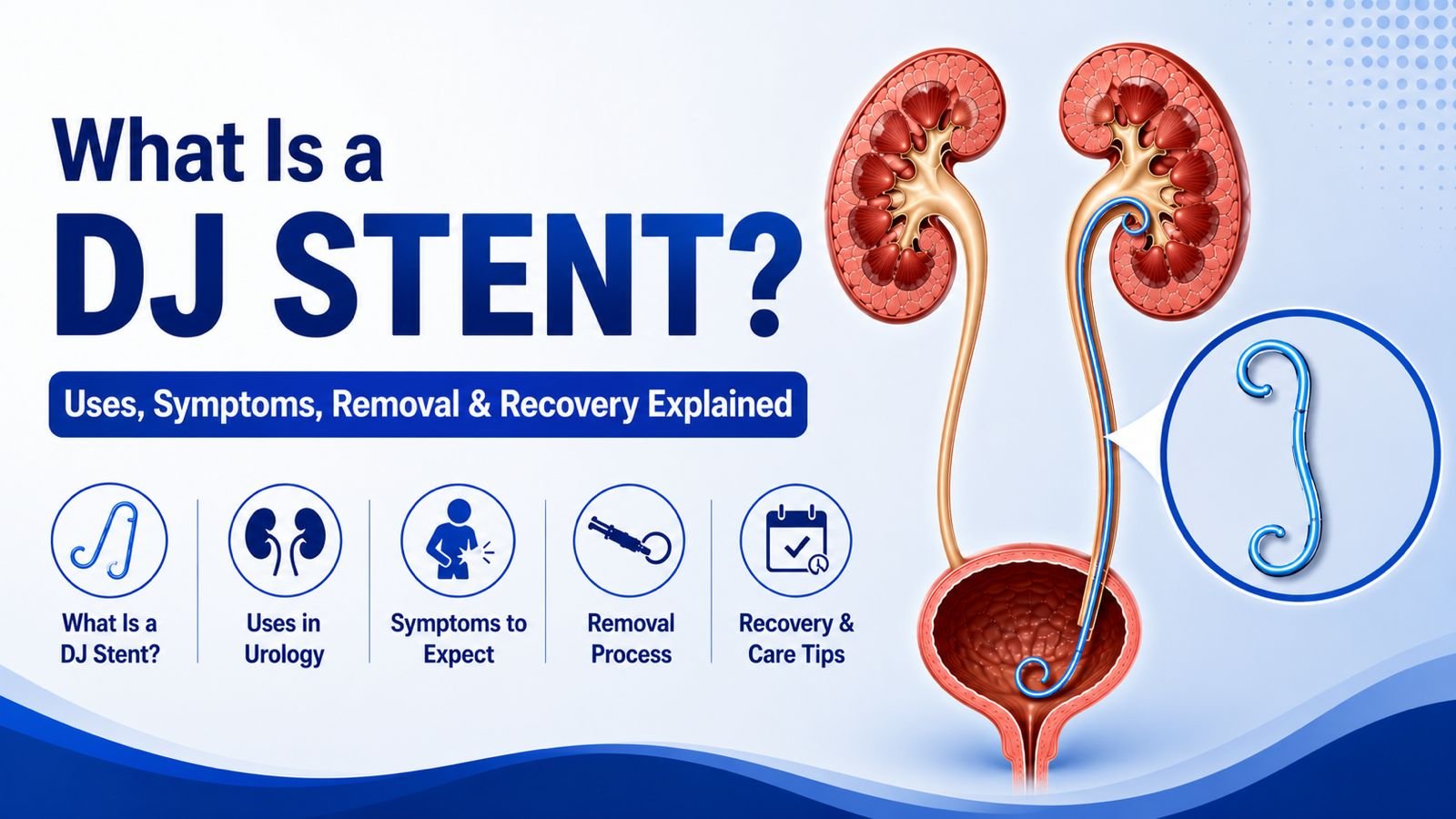
A DJ stent (Double J Stent) is a thin, flexible plastic tube placed inside the ureter — the tube that carries urine from the kidney to the bladder.
It is called a Double J stent because both ends are curled like the letter “J”:
- One end sits inside the kidney (renal pelvis)
- The other end sits inside the bladder
These curls hold the stent securely in position and prevent it from slipping out of place.
Why Is a DJ Stent Used?
The primary purpose of a DJ stent is to keep urine flowing freely from the kidney to the bladder while the ureter heals or while an obstruction is bypassed. It essentially acts as an internal drainage tube.
Common Reasons for DJ Stent Placement
1. After Kidney Stone Surgery
This is the most common indication. After procedures such as:
- URSL (Uretero-Renoscopic Lithotripsy)
- RIRS (Retrograde Intrarenal Surgery)
- PCNL (Percutaneous Nephrolithotomy)
the ureter may become swollen from stone manipulation. A DJ stent maintains drainage while this swelling settles and healing occurs.
2. Blocked Ureter Due to a Stone
A stone lodged in the ureter can block urine flow and cause severe pain, kidney swelling, and infection. A DJ stent bypasses the obstruction and protects kidney function until the stone is definitively treated.
3. Kidney Infection With Obstruction
When a stone causes infection and blockage at the same time, it can become a medical emergency. A DJ stent helps drain infected urine and relieve pressure on the kidney, often as an urgent, life-saving step.
4. PUJ or Ureteric Reconstruction Surgery
After surgeries such as pyeloplasty, ureteric reimplantation, or ureteroureterostomy, a DJ stent supports the healing of the newly reconstructed junction.
5. Ureteric Stricture
Narrowing of the ureter can impair urine flow. Stents may be used temporarily, or occasionally on a long-term basis, to maintain drainage in select cases.
What Does a DJ Stent Look Like?
Picture a soft plastic tube approximately:
- 4.8–6 Fr in diameter
- 22–30 cm in length
Both ends curl naturally once inside the body to prevent migration. The stent remains entirely inside the body — patients cannot see it, and it has no external component.
Can You Feel a DJ Stent?
Some patients hardly notice it at all. Others may experience mild to moderate urinary symptoms, which are usually expected and temporary.
Common Symptoms After DJ Stent Placement
Frequent Urination The bladder end of the stent can irritate the bladder lining, leading to more frequent trips to the washroom.
Urgency A sudden, strong need to pass urine is common.
Burning During Urination Mild discomfort while passing urine is normal with a stent in place.
Flank Pain During Urination Some patients feel temporary pain in the kidney region while voiding — this is known as reflux pain, caused by urine briefly flowing back toward the kidney during bladder contraction.
Blood in Urine Small amounts of blood in the urine can occur, especially after physical activity or exercise.
Are These Symptoms Normal?
Mild versions of the symptoms above are expected and usually manageable. However, you should contact your urologist promptly if you develop:
- High fever
- Severe, unrelenting pain
- Inability to pass urine
- Heavy bleeding with clots
These may indicate infection, stent blockage, or another complication requiring urgent attention.
How Is a DJ Stent Inserted?
DJ stent placement is usually performed using a cystoscope, a thin telescope passed through the urinary passage.
The procedure:
- Is done under anesthesia (usually the same anesthesia as the main stone surgery).
- Does not require any external cuts or incisions.
- Usually takes only a short time to complete.
Most patients go home the same day or the following day.
How Long Does a DJ Stent Stay Inside?
Duration depends on the underlying condition being treated:
| Procedure | Typical Stent Duration |
|---|---|
| After URSL | 1–4 weeks |
| After RIRS | 1–3 weeks |
| After Pyeloplasty | 4–8 weeks |
Your urologist determines the exact timing based on your specific case and healing progress.
Why Is Timely Removal Important?
One of the most important messages for every patient:
Never forget your DJ stent.
A forgotten or “retained” stent left in place beyond the advised duration can develop:
- Stone formation on the stent surface
- Encrustation (calcium deposits hardening on the tube)
- Infection
- Blockage of the ureter
In severe, neglected cases, additional and more complex surgery may be required to remove a heavily encrusted stent. Always follow your scheduled stent removal date, and set a personal reminder if needed.
How Is a DJ Stent Removed?
Removal is usually a simple, quick outpatient procedure. A small flexible cystoscope is passed through the urinary passage, and the stent is gently withdrawn. The procedure typically takes only a few minutes, and most patients go home immediately afterward.
DJ Stent Care and Follow-Up in Jaipur
Patients undergoing kidney stone surgery in Jaipur — whether at a private hospital or a government facility such as SMS Hospital or RUHS Hospital — are typically given a written stent removal date at the time of discharge. Patients covered under Ayushman Bharat should confirm stent removal scheduling and follow-up visits with their treating hospital’s help desk to avoid delays. Post-operative medications, including antibiotics and pain relief, are often available affordably through Jan Aushadhi Kendra outlets across the city.
If you are unsure of your stent removal date or have misplaced your discharge summary, contact your treating urologist’s clinic directly rather than waiting for symptoms to appear.
Frequently Asked Questions (FAQs)
Can I travel with a DJ stent?
Yes, most patients can travel normally unless specifically advised otherwise by their urologist.
क्या DJ स्टेंट के साथ यात्रा की जा सकती है? हाँ, अधिकतर मरीज सामान्य रूप से यात्रा कर सकते हैं, जब तक कि यूरोलॉजिस्ट द्वारा विशेष रूप से मना न किया जाए।
Can I exercise with a DJ stent?
Light activities are usually permitted, but strenuous exercise or heavy lifting may worsen urinary symptoms or discomfort and should be avoided until the stent is removed.
क्या DJ स्टेंट के साथ व्यायाम किया जा सकता है? हल्की गतिविधियों की अनुमति आमतौर पर होती है, लेकिन कठिन व्यायाम या भारी वजन उठाने से लक्षण बढ़ सकते हैं, इसलिए स्टेंट निकलने तक इनसे बचना चाहिए।
Can a DJ stent move inside the body?
Migration is uncommon because both ends of the stent are curled to hold it securely in position within the kidney and bladder.
क्या DJ स्टेंट शरीर के अंदर खिसक सकता है? यह दुर्लभ होता है क्योंकि स्टेंट के दोनों सिरे मुड़े हुए (curled) होते हैं, जो इसे किडनी और ब्लैडर में सही स्थिति में बनाए रखते हैं।
Is DJ stent removal painful?
Most patients tolerate the removal procedure well, with only brief, temporary discomfort during the process.
क्या DJ स्टेंट निकालने में दर्द होता है? अधिकतर मरीज इस प्रक्रिया को अच्छी तरह सहन कर लेते हैं, इस दौरान केवल थोड़ी देर के लिए हल्की असुविधा हो सकती है।
Can I work with a DJ stent?
Many patients continue routine office and desk work while the stent is in place, adjusting for any urinary urgency or mild discomfort.
क्या DJ स्टेंट के साथ काम किया जा सकता है? कई मरीज स्टेंट लगे रहने के दौरान भी अपना नियमित ऑफिस और डेस्क का काम जारी रखते हैं, हल्की असुविधा के अनुसार समायोजन करते हुए।
When Should You See a Urologist?
Seek medical advice promptly if you experience:
- Persistent flank pain
- Symptoms suggestive of new kidney stones
- Recurrent urinary infections
- Blood in urine that is heavy or contains clots
- Difficulty passing urine
- Fever accompanied by urinary symptoms
Key Takeaway
A DJ stent is a temporary internal drainage tube that helps urine flow freely from the kidney to the bladder. It is commonly used after kidney stone surgery, during urinary obstruction, and following reconstructive urological procedures. While mild urinary symptoms are common and expected with a stent in place, timely removal on your scheduled date is essential to avoid complications such as encrustation, infection, or stone formation.
If you have a DJ stent in place and are unsure about your removal date or are experiencing concerning symptoms, consult your urologist without delay.
This article is written for general patient education and does not replace an in-person consultation. For any concerns regarding a DJ stent, kidney stones, or urinary symptoms, please consult a qualified urologist.
About the Author: Dr. Mohit Sharma is an MCh Urology specialist trained at AIIMS, with clinical expertise in kidney stone disease, endourology, and minimally invasive urological surgery. He is the founder of UROWALA, a urology patient education and consultation platform based in Jaipur, Rajasthan.