
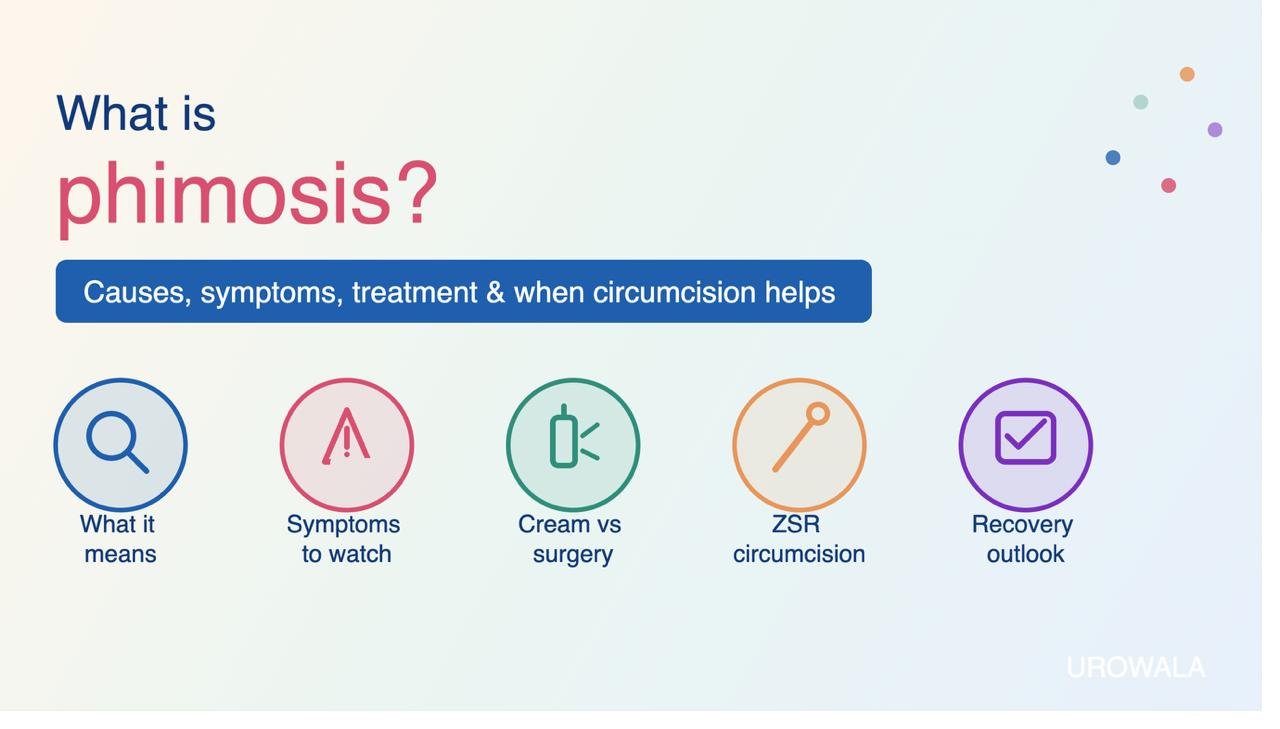

Introduction
Many boys and men experience difficulty pulling back the foreskin over the head of the penis. While this can be entirely normal in young children, persistent tightness in older children, teenagers, or adults may indicate a condition called phimosis.
Left untreated, phimosis can lead to pain, recurrent infections, difficulty maintaining hygiene, and problems during urination or sexual activity. The good news is that effective treatment options exist, ranging from simple topical therapy to minor surgical correction.
What Is Phimosis?
Phimosis is a condition in which the foreskin (prepuce) cannot be pulled back completely over the glans (head) of the penis. The opening of the foreskin becomes too tight, preventing normal retraction.
Is Phimosis Normal in Children?
Yes. Many newborns and young boys naturally have a non-retractile foreskin — this is known as physiological phimosis and usually improves gradually as the child grows. Most children in this category do not require any treatment and simply need periodic observation.
When Does Phimosis Become a Problem?
Phimosis may need medical attention when it causes:
- Pain during foreskin retraction
- Ballooning of the foreskin during urination
- Recurrent infections
- Difficulty maintaining hygiene
- Painful erections
- Difficulty during sexual activity
Common Symptoms of Phimosis
Tight Foreskin The foreskin cannot be retracted fully over the glans.
Pain During Retraction Attempting to pull back the foreskin may cause discomfort or sharp pain.
Pain During Erection Teenagers and adults may experience painful erections due to the restricted tissue.
Difficulty Passing Urine In severe cases, the urine stream may become thin or weak due to obstruction.
Recurrent Infections Poor hygiene from restricted access increases the risk of:
- Balanitis (inflammation of the glans)
- Balanoposthitis (inflammation of the glans and foreskin together)
- Urinary tract infections
What Causes Phimosis?
Physiological Phimosis
A normal developmental stage seen in infants and young children, which typically resolves on its own with time.
Pathological Phimosis
May develop due to:
- Recurrent infections
- Scarring from prior irritation or injury
- Forceful retraction of the foreskin (often attempted by well-meaning caregivers)
- Inflammatory skin disorders such as lichen sclerosus (BXO)
- Diabetes in adults, which increases susceptibility to infection-related scarring
What Is BXO?
Balanitis Xerotica Obliterans (BXO) is a chronic inflammatory skin condition that causes progressive scarring of the foreskin. Signs may include:
- A white, scarred ring around the foreskin opening
- Severe, progressive tightening
- Increasing difficulty retracting the foreskin over time
BXO is a distinct pathological process from simple physiological phimosis and often requires surgical treatment, as topical therapy alone is frequently insufficient.
Can Phimosis Cause Pain?
Yes. Patients commonly experience:
- Pain while attempting to retract the foreskin
- Pain during erections
- Pain during sexual intercourse
- Cracking or bleeding of the foreskin tissue, particularly at the tight opening
How Is Phimosis Diagnosed?
Physical Examination
A urologist evaluates:
- Degree of foreskin tightness
- Presence of scarring (which may suggest BXO)
- Signs of active infection
- Any associated conditions
Special investigations are rarely needed — diagnosis is usually straightforward on clinical examination alone.
Treatment Options for Phimosis
Treatment depends on the patient’s age, the severity of tightness, and the underlying cause.
Observation
Many children with physiological phimosis improve naturally without any intervention and simply need periodic review.
Topical Steroid Creams
In selected cases, a prescribed steroid cream combined with gentle stretching exercises can significantly improve foreskin retractability over several weeks, avoiding the need for surgery.
Treatment of Infection
If an active infection is present, it must be appropriately treated before or alongside definitive management of the tightness itself.
Circumcision
Circumcision remains the definitive treatment for significant pathological phimosis, particularly cases involving BXO or those that fail to respond to conservative therapy.
What Is Circumcision?
Circumcision is a surgical procedure in which the foreskin is removed. Benefits include:
- A permanent solution to foreskin tightness
- Improved hygiene
- Elimination of retraction-related pain
- Reduced risk of recurrent infections
Modern Circumcision Techniques
Stapler Circumcision (ZSR Circumcision)
A modern technique that offers several advantages:
- Shorter procedure time
- Minimal bleeding
- Faster recovery
- Good cosmetic results
This technique has become increasingly popular for its efficiency and patient comfort.
Conventional Circumcision
A well-established, time-tested surgical option that remains appropriate for many patients, particularly in cases with significant scarring where precise tissue handling is required.
The most suitable technique depends on individual anatomy, the underlying cause of phimosis, and the surgeon’s assessment — this is best discussed during an in-person consultation.
What Happens If Phimosis Is Ignored?
Untreated, significant phimosis may lead to:
- Recurrent infections
- Painful intercourse
- Urinary difficulties
- Progressive scarring
- Paraphimosis — a medical emergency
What Is Paraphimosis?
Paraphimosis occurs when a tight foreskin is pulled back behind the glans and becomes trapped, unable to return to its normal position. This can cut off blood flow to the glans and requires urgent medical attention.
Symptoms include:
- Severe swelling of the glans
- Significant pain
- Visible difficulty or inability to return the foreskin to its normal position
If this occurs, seek emergency urological care immediately rather than waiting for a routine appointment.
Phimosis Care and Circumcision in Jaipur
Patients in Jaipur and across Rajasthan have access to both conservative and surgical management of phimosis, including modern stapler (ZSR) circumcision techniques. A few points relevant to local patients:
- Government facilities such as SMS Hospital, Jaipur and RUHS Hospital offer urology consultation and circumcision services.
- Patients covered under Ayushman Bharat should confirm eligibility for circumcision procedures with their chosen hospital in advance, as coverage can vary by indication and facility empanelment.
- Topical steroid creams and post-procedure medications are often available affordably through Jan Aushadhi Kendra outlets across the city.
If your child has a tight foreskin, or if you as an adult are experiencing pain, recurrent infections, or difficulty during intercourse, a proper evaluation by a urologist will clarify whether observation, cream-based therapy, or circumcision is the right path forward.
Frequently Asked Questions (FAQs)
What is phimosis?
Phimosis is a condition in which the foreskin cannot be fully retracted over the head of the penis due to tightness of the foreskin opening.
फिमोसिस क्या है? फिमोसिस एक ऐसी स्थिति है जिसमें फोरस्किन (चमड़ी) के छिद्र के कसे होने के कारण उसे लिंग के सिरे पर पूरी तरह पीछे नहीं खींचा जा सकता।
Why is my foreskin not retracting?
This may be due to physiological phimosis, which is normal in young children, or pathological phimosis caused by scarring, infection, forceful retraction, or a skin condition such as BXO.
मेरी चमड़ी पीछे क्यों नहीं जा रही है? यह छोटे बच्चों में सामान्य फिजियोलॉजिकल फिमोसिस के कारण हो सकता है, या फिर स्कारिंग, इन्फेक्शन, जबरदस्ती चमड़ी खींचने, या BXO जैसी त्वचा संबंधी स्थिति के कारण पैथोलॉजिकल फिमोसिस हो सकता है।
Can phimosis cause pain?
Yes. It can cause pain during retraction, during erections, during intercourse, and may lead to cracking or bleeding of the foreskin tissue.
क्या फिमोसिस से दर्द हो सकता है? हाँ। इससे चमड़ी पीछे खींचते समय, इरेक्शन के दौरान, संभोग के दौरान दर्द हो सकता है, और चमड़ी में दरार या रक्तस्राव भी हो सकता है।
Does phimosis always require circumcision?
No. Mild cases, particularly in children, often respond to observation or topical steroid cream with stretching exercises. Circumcision is reserved for significant or persistent cases, especially those involving scarring or BXO.
क्या फिमोसिस में हमेशा खतना (सुन्नत) की जरूरत होती है? नहीं। हल्के मामलों में, खासकर बच्चों में, केवल निगरानी या स्टेरॉयड क्रीम और स्ट्रेचिंग एक्सरसाइज से सुधार हो सकता है। खतना गंभीर या लगातार बने रहने वाले मामलों में किया जाता है, खासकर स्कारिंग या BXO से जुड़े मामलों में।
What is the best treatment for phimosis?
The best treatment depends on age, severity, and underlying cause — options range from observation and topical steroid creams in mild cases to circumcision (including modern ZSR stapler technique) in significant or scarred cases.
फिमोसिस का सबसे अच्छा इलाज क्या है? सबसे अच्छा इलाज उम्र, गंभीरता, और मूल कारण पर निर्भर करता है — हल्के मामलों में निगरानी और स्टेरॉयड क्रीम से लेकर गंभीर या स्कारिंग वाले मामलों में खतना (आधुनिक ZSR स्टेपलर तकनीक सहित) तक विकल्प उपलब्ध हैं।
What happens if phimosis is left untreated?
Untreated significant phimosis can lead to recurrent infections, painful intercourse, urinary difficulties, progressive scarring, and paraphimosis, which is a medical emergency requiring urgent treatment.
अगर फिमोसिस का इलाज न कराया जाए तो क्या होगा? इलाज न कराने पर बार-बार इन्फेक्शन, संभोग के दौरान दर्द, पेशाब में कठिनाई, स्कारिंग बढ़ना, और पैराफिमोसिस जैसी स्थिति हो सकती है, जो एक मेडिकल इमरजेंसी है और तुरंत इलाज की आवश्यकता होती है।
When Should You See a Urologist?
Seek medical evaluation if:
- The foreskin cannot be retracted
- Retraction causes pain
- Recurrent infections occur
- There is difficulty passing urine
- The foreskin develops scarring or cracking
- A tight foreskin becomes trapped behind the glans and will not return to normal position (seek emergency care)
Key Takeaway
Phimosis is a common condition in which the foreskin does not retract easily over the head of the penis. While many cases in young children improve naturally with time, persistent tightness, pain, infections, or urinary symptoms should be evaluated by a urologist. Modern treatments — ranging from topical therapy to minimally invasive circumcision techniques like ZSR stapler circumcision — offer effective and long-lasting relief.
This article is written for general patient education and does not replace an in-person consultation. For evaluation of phimosis, foreskin problems, or paraphimosis, please consult a qualified urologist promptly, especially in emergency situations.
About the Author: Dr. Mohit Sharma is an MCh Urology specialist trained at AIIMS, with clinical expertise in men’s health, pediatric urology, and minimally invasive urological procedures. He is the founder of UROWALA, a urology patient education and consultation platform based in Jaipur, Rajasthan.